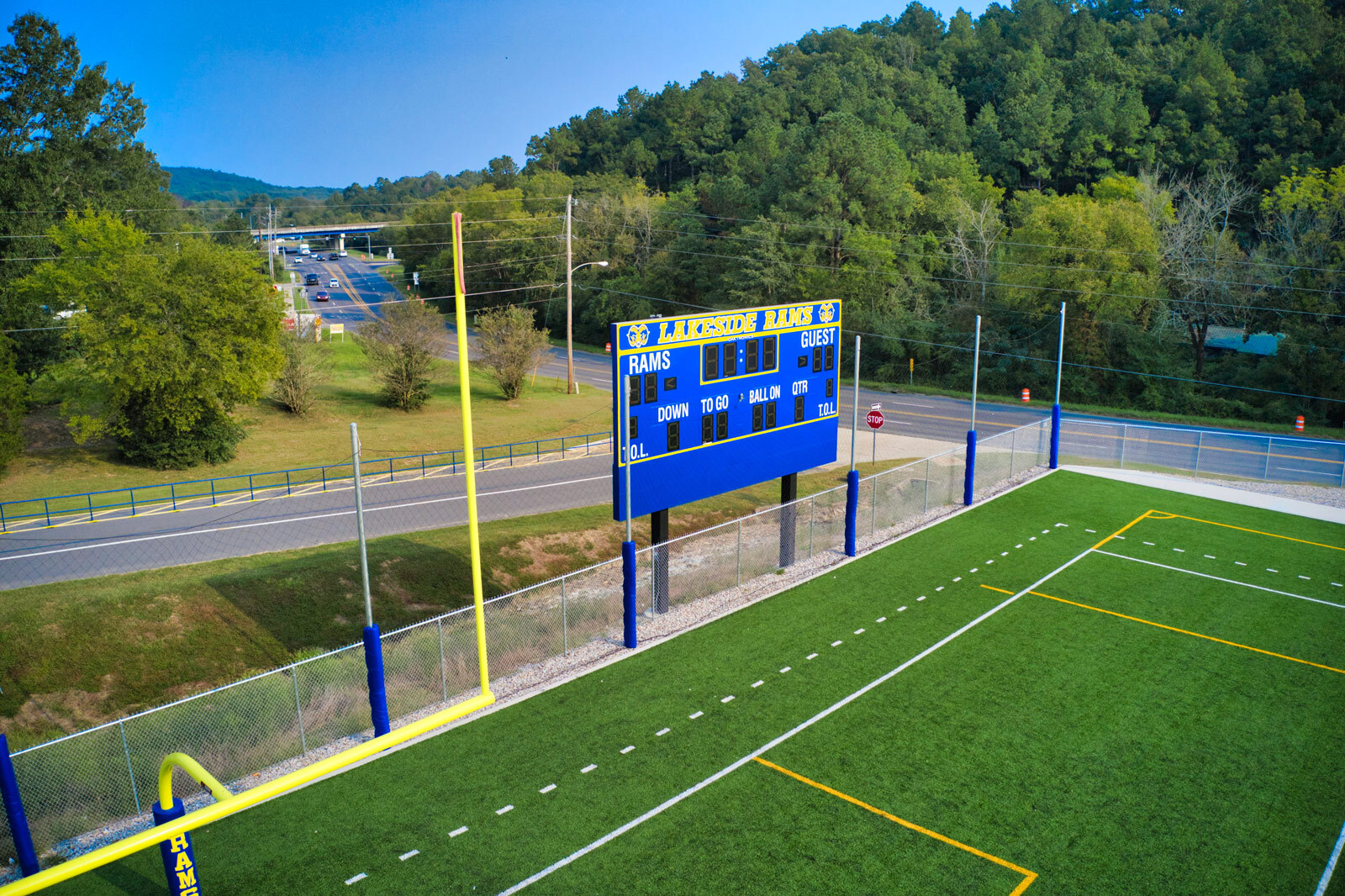
School security fencing should provide a clear perimeter boundary, support natural visibility across campus grounds, and channel visitor traffic to controlled entry points. The best school security fencing combines adequate height, open material profiles, and access control integration. Ornamental steel and anti-climb welded mesh consistently outperform chain link for primary perimeter applications at K-12 facilities.
Key Takeaways
- Security and Appearance Balance: School fencing must be secure and welcoming, a tension most commercial properties rarely face.
- CPTED Principles: Natural surveillance, access control, and territoriality directly determine fence height, material, and placement.
- Fencing Types by Zone: Ornamental steel, anti-climb welded mesh, and chain link each serve different campus zones and threat levels.
- Height Standards: Perimeter fencing should stand 6 to 8 feet tall, with gates matched to the same height.
- Gate Design: All visitor traffic should funnel to one monitored entry point, eliminating informal access paths.
- Custom Fabrication: In-house fabrication supports non-standard dimensions and compressed project timelines.
- Local Expertise: United Fence Company has served Central Arkansas schools and commercial properties for over 70 years.
Jump to: What Makes School Security Fencing Different | What Are the Best Fencing Types | How Tall Should It Be | Gates and Access Control | What to Evaluate
Picture this: a 40-year-old chain link fence at your local elementary school needs replacing. However, the facilities director barely begins the process when an argument usually gets in the way. The board wants something that doesn’t look “like a prison yard.” The principal wants a barrier that “actually keeps unauthorized people off campus.” And somewhere in the background, the budget is already smaller than anyone hoped, or is planning for. Finding the best school security fencing means answering multiple demands, such as the ones laid out above.
That challenge is not purely a product selection problem. It involves understanding how physical design affects behavior, how fence material affects sight-lines, and how a gate layout either supports or undermines everything the fence is supposed to accomplish. The wrong specification does not just look bad. It creates gaps that a perimeter fence was supposed to close.
What Makes School Security Fencing Different from Standard Commercial Fencing?
School security fencing is not commercial fencing applied to a campus. It is a distinct specification category because schools carry a set of competing requirements that most commercial properties never encounter.
A fence that looks like a threat can undermine the atmosphere. Parents notice it on drop-off day, staff feel it every morning, and the community reads it as a sign that something is wrong. But a fence that looks welcoming and lets anyone walk through an uncontrolled gap is not a security measure, it is decoration. The design has to hold both things at once.
That is where Crime Prevention Through Environmental Design (CPTED) comes in. CPTED is an industry-standard security planning framework, not something specific to any one contractor, and it breaks the problem into three principles. Natural surveillance means the environment is designed so people can see and be seen: no blind spots, no hidden corners. Access control means movement gets funneled through defined, monitored entry points instead of scattered across an open perimeter. Territoriality means the physical layout communicates where public space ends and secured campus begins. Every fencing decision maps to one of those three: how open the material profile is, where the gates go, and how the fence line sits relative to sidewalks and parking areas.
The CISA K-12 School Security Guide (3rd Edition) describes physical security in four concentric layers: the grounds perimeter, the school grounds, the building perimeter, and the building interior. Perimeter fencing is the outermost layer. It is the first physical boundary an unauthorized person encounters, and it sets the conditions for everything inside it. Getting that outer layer right does not guarantee safety, but getting it wrong puts pressure on every layer that follows.
Deliberate design is what bridges the gap between security and aesthetics. The best school security fencing decisions start with understanding which materials, configurations, and placement strategies serve each goal, and that starts with getting the material selection right.
What Are the Best Fencing Types for School Perimeter Security?
Not every fencing material belongs on every part of a school campus. Ornamental steel, anti-climb welded mesh, and chain link each do different jobs well, and matching the right material to the right zone is where a security perimeter actually comes together. A single specification applied everywhere usually means you have made the right choice nowhere.
| Fencing Type | Best For | Security Level | Visibility | Typical School Application |
|---|---|---|---|---|
| Chain link | Budget perimeters, athletic fields | Moderate | High | Playgrounds, sports courts |
| Ornamental steel | Front entrances, administrative areas | High | High | Main campus perimeter, admin buildings |
| Anti-climb welded mesh | High-concern perimeter sections | Very High | Moderate | Back perimeters, utility areas |
| Temporary fencing | Construction zones, special events | Low-Moderate | High | Active construction on campus |
That zone-based distinction is the starting point for every school perimeter plan. The data reinforces why it matters: according to Campus Safety Magazine, 80% of school shootings occur outside the building. Perimeter fencing is foundational, not an upgrade.
Why is ornamental steel ideal for front-facing school perimeters?
Ornamental steel handles two competing demands that most fencing materials cannot satisfy simultaneously: a hard perimeter that holds up to real security pressure, and open sight-lines so staff can actually see what is happening from reception desks and administrative windows.
Ornamental steel fencing gets specified at campus fronts for exactly that reason. No picket gaps wide enough to create blind spots. Powder coat that weathers Arkansas humidity and ice cycles without becoming a maintenance line item. And an appearance that reads “institution” rather than “lockdown.” School boards care about that distinction. Parents notice it. For campuses from Little Rock to Conway, ornamental steel pulls perimeter security and curb appeal into the same specification without sacrificing either.
When should schools specify anti-climb welded mesh?
Anti-climb fencing is the right choice for perimeter sections where unauthorized access is most likely to be attempted, particularly back-of-campus sections, utility access areas, and stretches that border public foot traffic or adjacent commercial property.
Still Comparing Your Options?
When you are ready to get specifics for your property, our team can walk you through materials, security ratings, and installation timelines for your site. United Fence & Construction works exclusively with commercial clients across Central Arkansas.
Anti-climb fencing uses rigid double vertical wire construction with mesh openings too small for footholds or handholds, which eliminates the climbing routes that standard chain link makes available. Visibility is moderate rather than high, which works well in those locations because staff surveillance typically focuses on building entrances and primary access points. Where the risk profile is elevated, anti-climb welded mesh closes that gap.
Where does chain link fencing fit in a school security plan?
Chain link fencing is a cost-effective, high-visibility option for secondary perimeters, athletic fields, playgrounds, and sports courts. It performs well in those contexts.
For a primary school perimeter at a high-concern campus, chain link alone does not provide sufficient deterrence. The mesh openings are large enough to climb, and the material offers limited resistance to a determined attempt at forced entry. Reserve it for athletic zones and secondary perimeters; use ornamental steel or anti-climb mesh at the primary perimeter line.
Specifying the right material for each zone is only half the equation. The other half is getting height, mesh spacing, and installation details right across every section of the perimeter.
How Tall Should School Security Fencing Be?
Height is your first line of deterrence. A taller fence takes more time and effort to breach, and that delay is often enough to redirect a threat entirely.
For elementary and K-8 campuses, a 6-foot perimeter fence is the accepted minimum. Middle and high schools benefit from 6 to 8 feet along the primary perimeter, with 8 feet or more warranted around utility areas, sensitive zones, or sections that run adjacent to public roads or high-traffic corridors.
Height alone, though, tells only part of the story. Anti-climb performance depends on height and mesh spacing working together. Chain link and welded wire mesh with openings less than 4 inches wide eliminate the footholds a climber needs to ascend, even at moderate heights. Specify the wrong mesh, and a taller fence still presents a climbable surface.
ADA compliance is a code requirement at every school perimeter gate. Gates must provide a minimum clear opening of 36 inches to accommodate wheelchairs, a firm and stable path to the gate, and hardware operable with one hand without tight grasping or twisting. These requirements belong in the specification from the start, not as an afterthought at final inspection.
Installers working in Central Arkansas also need to account for terrain. Campuses across the region vary considerably in slope, and a fence that follows a grade change with rigid panels will leave gaps between the fence bottom and the ground. Rackable panels are fabricated to follow those contours, closing the gap that a standard installation would leave open. Not every fence contractor carries in-house fabrication capability, which means this detail often gets missed until after installation.
Getting height, mesh configuration, and terrain installation right means the fence actually does its job. With that passive layer handled, the next question is how people move through it.
What Role Do Gates and Access Control Play in School Security?
Gates are where your perimeter either holds or breaks down. A gate that does not match the fence height, fails to latch reliably, or opens to an unmonitored area undermines every other specification decision you made.
The most effective school perimeters channel all arrivals, including parents, vendors, and contractors, to a single monitored entry point. This is a core CPTED access control principle, and it works because it removes the ambiguity of multiple entry paths. Staff or a camera system controls who enters and when, and every other access point remains secured.
Modern commercial gate systems are built to integrate with the electronic access control infrastructure most school campuses already use or are planning to add. Card readers, intercoms, camera systems, and remote gate operators connect to a central platform, giving administrators visibility and control from a single interface. Specifying a gate system that can support that integration from the start is more cost-effective than retrofitting later.
Emergency egress often gets overlooked when schools plan perimeter security independently from fire safety requirements. Padlocking a gate against egress is a fire code violation regardless of security intent, and gates must allow occupants to exit during an emergency without obstruction. Coordinate fence and gate specifications with your fire safety plan from the beginning.
United Fence Company installs and services gate systems across Central Arkansas, including Little Rock, Conway, Bryant, and Benton. A gate that fails during morning drop-off or during an emergency is a problem, and properly functioning access control is something institutional campuses cannot afford to treat as an afterthought.
Gate systems require regular maintenance. A latch that no longer engages or a hinge that sags creates a security gap that looks closed but is not. UFC’s commercial fence and gate repairs team handles this kind of ongoing service for campuses across Central Arkansas.
What Should Facility Managers Evaluate When Specifying School Security Fencing?
Specifying best school security fencing requires evaluating both the physical system and the contractor delivering it. Get both right, and you end up with a perimeter that performs for decades; get either wrong, and you face costly corrections during the school year.
What specification criteria should facility managers define before getting bids?
Contractors bid more accurately when you have already defined what you need. Pin down your key parameters before you make the first call: it saves rounds of back-and-forth and keeps specs consistent across bids. The table below summarizes the four criteria that most affect both security performance and long-term cost.
| Specification Criterion | What to Define | Why It Matters |
|---|---|---|
| Height and spacing | Fence height (6 ft minimum for K-8; 6-8 ft for 6-12) and mesh opening size (under 4 inches for anti-climb performance) | Height and mesh spacing work together to deter climbing; getting one wrong without the other leaves a climbable surface |
| Visibility | Open vs. solid panel sections; where sight-lines must be preserved vs. where privacy is acceptable | Open designs support staff and camera surveillance; overusing solid panels creates blind spots that reduce security coverage |
| Material durability | Specify galvanized steel with powder-coat finish or commercial-grade aluminum for Central Arkansas climate conditions | Hot, humid summers and freeze-thaw winters accelerate coating failure on lower-grade materials; durability protects the investment over the full service life |
| Access control compatibility | Gate hardware specs, electronic access control system integration requirements, and emergency egress compliance | Retrofitting incompatible gate systems after installation costs significantly more than specifying compatibility upfront |
What questions should facility managers ask every contractor?
Most facility managers focus on price. The contractors who deliver the best outcomes also answer well on capability and process. Ask every contractor these questions before awarding a project.
- Do you fabricate custom dimensions in-house, or do you depend on third-party fabricators?
- Do you handle both installation and commercial fence and gate repairs, or do you subcontract repairs?
- What is your lead time on custom work, particularly during summer installation windows?
- Have you completed institutional and school-campus projects in Central Arkansas?
Why does in-house fabrication matter for school fencing projects?
Contractors with in-house fabrication capability deliver faster lead times, tighter tolerances on custom dimensions, and full accountability from design through installation. School installation windows are typically compressed into summer break, and a delay in fabricated components can push a project into the school year. United Fence Company fabricates in-house at its Central Arkansas facility, which means fewer schedule variables on school projects.
What regulatory requirements apply to school perimeter fencing?
School perimeter fencing falls under local permit requirements, fire safety codes, ADA accessibility standards, and Arkansas building codes. A contractor without deep local experience may not flag compliance issues until the final inspection.
United Fence Company has served institutions across Little Rock, North Little Rock, Conway, Benton, Bryant, Jacksonville, Sherwood, and Maumelle for over 70 years, working through compliance reviews on dozens of commercial fencing projects throughout Central Arkansas. That institutional knowledge is most useful at the start of a project, when a potential code issue can be caught in conversation rather than corrected with a change order.
School administrators tend to ask the same questions when they start planning a perimeter project. Here are the ones that come up most.
Frequently Asked Questions
What is the best fencing for school security?
The right fencing type depends on the zone. Ornamental steel works best for front entrances and main perimeter areas where visibility and aesthetics both matter. Anti-climb welded mesh is the better choice for high-concern back perimeters and utility areas, where containment is the priority. Chain link remains a practical, cost-effective option for athletic fields and secondary perimeters.
How tall should a school security fence be?
Elementary and K-8 campus perimeters should be at least 6 feet tall. Middle and high school perimeters typically call for 6 to 8 feet, reflecting higher threat assessments and older student populations. Anti-climb configurations require both adequate height and mesh openings under 4 inches to prevent footholds.
Does school fencing need to comply with ADA requirements?
Yes. Gates in any school perimeter fence must provide a minimum 36-inch clear opening, a firm and stable path leading to the gate, and hardware operable with one hand without tight gripping or twisting. These requirements apply to all institutional and commercial properties, and non-compliant gate configurations can expose a district to liability.
What is CPTED and how does it apply to school fencing?
CPTED (Crime Prevention Through Environmental Design) is an industry-standard security framework that uses physical design to reduce crime through three principles: natural surveillance (maintaining sight-lines), access control (funneling entry to monitored points), and territoriality (clearly marking campus boundaries). Well-specified best school security fencing addresses all three.
Can United Fence Company install fencing for schools in Central Arkansas?
Yes. United Fence Company has been installing commercial and institutional fencing across Central Arkansas for over 70 years. Schools, government facilities, and commercial properties throughout Little Rock, North Little Rock, Conway, Benton, Bryant, Jacksonville, Sherwood, and Maumelle have all relied on the team, who handle everything from the initial site assessment through installation, repairs, and gate system integration.
Should school gates match the fence height?
Yes. A gate lower than the surrounding fence creates an obvious vulnerability that undermines the entire perimeter design. Gates should match the perimeter fence height and incorporate anti-climb design consistent with the fence specification, ensuring the controlled entry point does not become the weakest link in the system.
The Right Fence Protects Every Morning and Every Emergency
Selecting the best school security fencing comes down to matching each element to its purpose: ornamental steel for front perimeters where presence and aesthetics matter, anti-climb welded mesh for high-concern sections where containment is the priority, chain link for athletic fields and secondary zones, and height calibrated to the threat level of each area. The contractor you choose matters as much as the material. United Fence Company brings over 70 years of institutional and commercial fencing experience in Central Arkansas, in-house fabrication capability, and full-service coverage from installation through ongoing repairs and gate systems, serving Little Rock, Conway, Benton, Bryant, and school and commercial campuses throughout the region. If your perimeter is due for an upgrade, request a quote and we will assess what each zone actually needs.