Jump to Section
Facility managers in Central Arkansas make commercial security fencing selections every year for sites that couldn’t be more different from each other: a utility substation outside Little Rock, a construction laydown yard near the river, a 200-unit apartment complex with a history of trespassing. Commercial security fencing options are not in short supply, and most vendors will hand you a quote that looks reasonable. The problem shows up later, usually after a theft, a liability claim, or an insurance audit that reveals the perimeter wasn’t rated for what it was asked to do.
That’s the real failure mode: not a fence that collapses, but one that was never wrong enough to question until something happened. Facility managers who lead with budget and back into threat assessment are making a common and costly mistake. The spec looks fine on paper, the price fits the approval threshold, and the gap in protection stays invisible. United Fence Company’s proposal process inverts that order. We start with threat level: what the site attracts, what it needs to resist, and what the consequences of a breach actually are. Product selection follows from that.
Start With Your Threat Level, Not Your Budget
Most facility managers approach commercial security fencing by asking what they can spend, then finding a product that fits. That approach produces one of two outcomes: over-spending on hardened systems a low-risk site doesn’t need, or under-protecting a high-value site with a chain link that a determined intruder will defeat quickly.
Threat level defines the right fence. Budget determines how you phase the installation.
Tier 1: Opportunistic deterrence. These sites face casual trespassers and low-effort unauthorized entry. Standard 9 or 11 gauge chain link at 6–8 ft height handles the majority of Tier 1 applications: storage facilities, general contractor yards, and standard warehouse perimeters. The fence needs to stop an unmotivated person, not a determined one.
Tier 2: Delay of determined intruders. Sites facing motivated theft, such as equipment at active construction sites, copper at commercial properties, and high-value inventory at distribution centers, need a fence that shifts from deterrence to delay. Heavier-gauge chain link or welded wire, anti-climb configurations, and barbed wire or razor-coil topping all add friction that matters, even if no fence stops a truly determined person indefinitely.
Tier 3: Forced-entry resistance. Utility substations, telecom infrastructure, and critical equipment storage face a different threat category. Anti-climb welded mesh systems meeting ASTM (American Society for Testing and Materials) F2781 standards are the baseline at Tier 3. Gate systems and access control integration are not optional; a high-specification fence with a standard swing gate is a hardened wall with an open door.
Commercial Chain Link Fencing: The Baseline for Most Properties
Commercial chain link fencing covers the majority of commercial security perimeters because it balances strength, cost, and visibility for Tier 1 and Tier 2 applications. The specification decision comes down to gauge and coating.
Gauge measures wire diameter: lower numbers mean heavier wire. 6 gauge is heavy industrial. 9 gauge is standard commercial, appropriate for warehouses, utility yards, and multi-family properties. 11 gauge suits low-threat boundary applications. 12 gauge is a general demarcation, not a security specification. Under-specifying gauge is common; an 11-gauge fence where 9-gauge is warranted fails over time and under pressure, not immediately.
Coating matters more in Central Arkansas than in most markets. The region’s humid subtropical climate accelerates corrosion. Galvanized is the standard specification. Aluminized performs better in sustained humid environments. Galfan (a zinc-aluminum alloy) offers the longest service life in corrosive conditions. Vinyl-coated adds an aesthetic finish and is common in institutional settings.
The Chain Link Fence Manufacturers Institute (CLFMI) identifies anti-climb performance thresholds by gauge and mesh: 1/2″ mesh, 9 gauge, and 3/8″ mesh, 11 gauge configurations demonstrate resistance to climbing and cutting per CLFMI Commercial Security System guidelines. Height is a parallel variable; 8 ft is the practical minimum for Tier 2 applications.
Still Comparing Your Options?
When you are ready to get specifics for your property, our team can walk you through materials, security ratings, and installation timelines for your site. United Fence & Construction works exclusively with commercial clients across Central Arkansas.
Anti-Climb and High-Security Fencing Options
Chain link deters. Welded wire mesh stops. That distinction defines the choice for any facility where a determined intruder must be physically prevented from breaching the perimeter.
The difference is rigidity. Chain link fabric flexes: the diamond pattern creates footholds and the fabric moves under load. Welded wire mesh panels are rigid by construction. Spacing configurations like 3/8″ x 3″ eliminate footholds entirely; the panel doesn’t deform under pressure and resists cutting attacks that flexible chain link cannot.
For Tier 2 applications, an 8 ft height with 3-strand barbed wire outrigger arms is the standard specification. Tier 3 moves to 10–12 ft with concertina or razor coil top treatment. Bottom treatment is routinely under-specified: securing the bottom rail and, where warranted, burying mesh in concrete eliminates crawling-under attack vectors that height alone doesn’t address.
ASTM F2781 governs forced-entry and ballistic-resistance performance testing for security-grade chain link. Per the CLFMI Security Fencing Guidelines, the 1/2″ mesh 9 gauge and 3/8″ mesh 11 gauge configurations show excellent results against F2781 criteria, a verifiable performance benchmark rather than a manufacturer’s claim.
Anti-climb fencing and high-security fence panels are specification decisions before they are product selections.
Industrial and Heavy-Duty Perimeter Fencing
Equipment storage yards, utility substations, and manufacturing facilities with outdoor material storage require heavier specifications than standard commercial chain link can provide. 6-gauge is the specification for these environments: the heavier wire diameter resists vehicle impacts, tool-based cutting attacks, and environmental deformation that lighter gauges fail against over time.
In Pulaski County, Little Rock, and North Little Rock’s industrial corridors, 6-gauge chain link commonly pairs with 10–12 ft height and heavy-duty terminal and line posts. Post specification follows the fence specification: undersizing posts against heavy-gauge fabric is a compounding error. Industrial fencing for these applications starts with the right gauge and builds outward.
Gate Systems and Access Control Integration
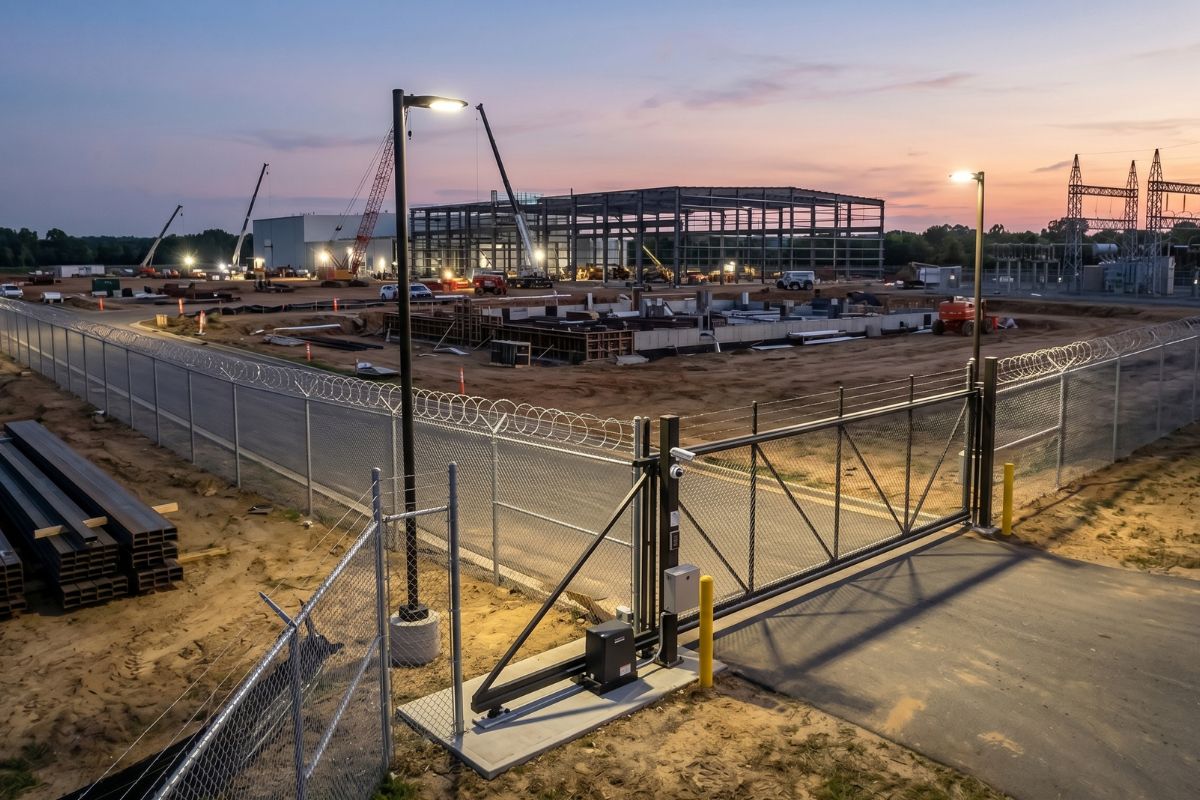
Gate systems are where perimeter security gets tested most often, and where under-specification causes the most problems. The perimeter fence establishes the boundary, but a well-built 6-gauge perimeter paired with an underpowered gate operator and a basic padlock doesn’t protect what the fence investment was intended to protect.
Gate type follows site geometry and traffic volume. Slide gates are the standard for high-traffic commercial entrances; they cycle frequently and accept electric operators. Swing gates fit lower-traffic applications or sites without slide clearance. Overhead or vertical lift gates resolve geometry constraints on tight urban parcels.
Access control scales with the property’s complexity: keypad entry for simple Tier 1 sites, card readers and proximity fobs (RFID) for Tier 2 properties with multiple authorized users, intercoms with cameras where an unmanned point requires verification. Automatic operators are required at any unmanned access point. Commercial gate systems specified to the same standard as the perimeter fabric complete the installation.
Why In-House Fabrication Matters for Security Specifications
In-house fabrication is what separates contractors who can execute security specifications from those who approximate them. Most commercial fencing contractors source from catalog stock: standard panel dimensions, off-the-shelf gate widths, catalog post spacing. For straightforward applications, that works. For security specifications, it introduces tolerance gaps.
Custom security work requires fabrication: non-standard gate widths for loading dock openings, specific mesh configurations for high-security zones, compound angles where an irregular property line meets a fence run. A contractor who sources from stock approximates these requirements. A contractor with on-site fabrication hits them.
In-house fabrication delivers dimensional accuracy, lead time control, and specification fidelity that stock sourcing cannot. United Fence Company has operated an on-site fabrication workshop since 1953, with seven decades of commercial work in Central Arkansas behind it. In-house commercial fence fabrication is what makes non-standard specifications executable on schedule.
How to Evaluate a Commercial Fencing Contractor
Start with fabrication capability: can the contractor build to your spec in-house, or are they reselling someone else’s product? Custom security work requires that capability. If they can’t fabricate, they can’t own the outcome when something doesn’t meet spec.
From there, look at their commercial history in this region specifically. Central Arkansas soil conditions, weather patterns, and permitting requirements are local knowledge, not transferable from another market. Ask about industrial, institutional, and government projects by name. A contractor with decades of that work here has seen conditions and edge cases that a newer or out-of-market firm simply hasn’t.
Scope matters too. Does the contractor handle design, fabrication, installation, and ongoing repair under one roof? When repairs get subcontracted, quality control and response time go with it. You want one accountable party who built the fence and stands behind it.
Finally, ask for references from comparable commercial properties in the region. Any contractor worth hiring will have them ready.
Common Questions About Commercial Security Fencing
What gauge chain link fencing should a commercial property use for security?
Commercial security applications typically call for 9-gauge or 6-gauge chain link (AWG: American Wire Gauge; lower numbers mean heavier wire). Standard 11-gauge is adequate for light commercial use, but secured perimeters, industrial yards, and detention applications require 9- or 6-gauge wire, which resists cutting and deformation under load. Match gauge to your threat level, not to the lowest bid.
How tall should commercial security fencing be?
Most commercial properties land somewhere between six and eight feet. That range handles the majority of applications: parking lots, equipment yards, loading docks. But if you’re specifying for a controlled-access perimeter, a utility site, or a detention facility, eight feet is the floor, not the target. Add barbed wire outriggers or razor coil and you’re picking up another 12 to 18 inches of effective height on top of that.
One thing to nail down before you finalize the spec: Arkansas building codes and local zoning both set upper limits depending on the area. Pull those requirements early. Changing the height after you’ve priced materials and labor is a headache nobody needs.
What is the difference between chain link fencing and welded wire mesh for security?
Chain link is a single continuous wire woven into a diamond pattern: flexible and cost-effective. Welded wire mesh is manufactured from intersecting wires fused at each joint, producing rigid panels that resist deformation and climbing. For high-security perimeters where anti-climb performance matters, welded wire mesh is the stronger specification. Chain link handles general commercial enclosures, equipment yards, and athletic facilities.
How often should commercial fencing be inspected and maintained?
Twice a year is the baseline: once in spring after freeze-thaw cycles have done their work on posts and footings, and again in the fall before the next hard freeze. Add an inspection after any severe weather event. You’re looking for bent posts, broken welds, stretched fabric, compromised hardware, and gates that no longer close clean. A security perimeter with deferred maintenance doesn’t just fail; it creates documented exposure when something goes wrong on your property.
Work With a Commercial Fencing Contractor Who Stays Accountable
With more than 70 years of commercial fencing work across Central Arkansas, United Fence Company designs, fabricates, installs, and repairs fencing systems from its on-site workshop. That means one point of accountability from specification through the life of the installation. When you’re ready to assess your site and build the right system for your threat level and budget, request a quote and we’ll come to you.